Skip to content
Live · part of Class Cookies

59 Seconds

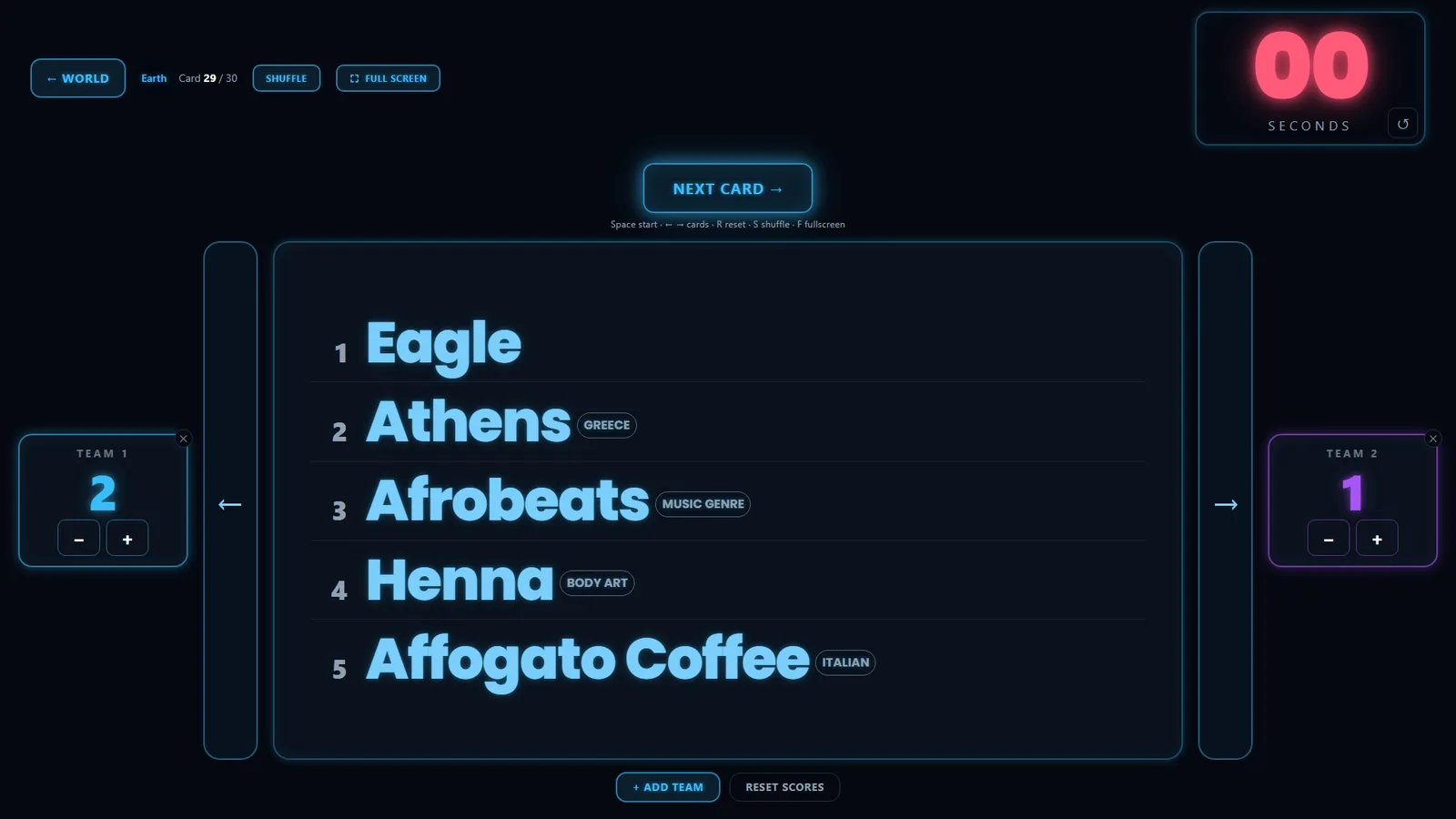
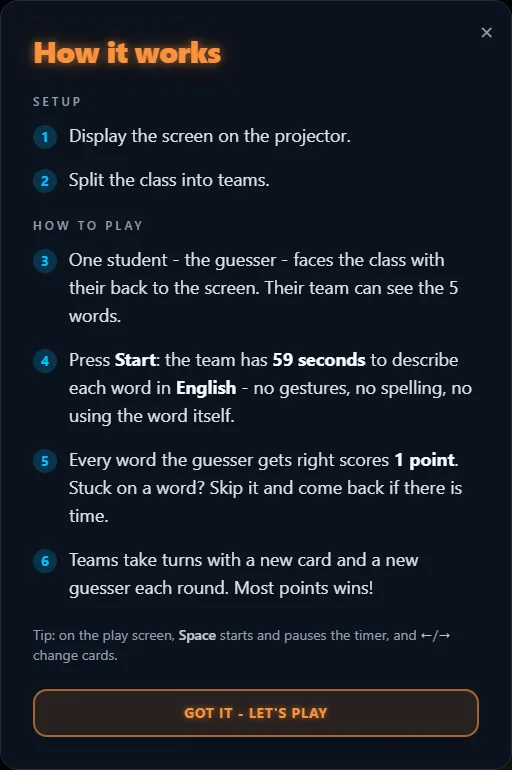
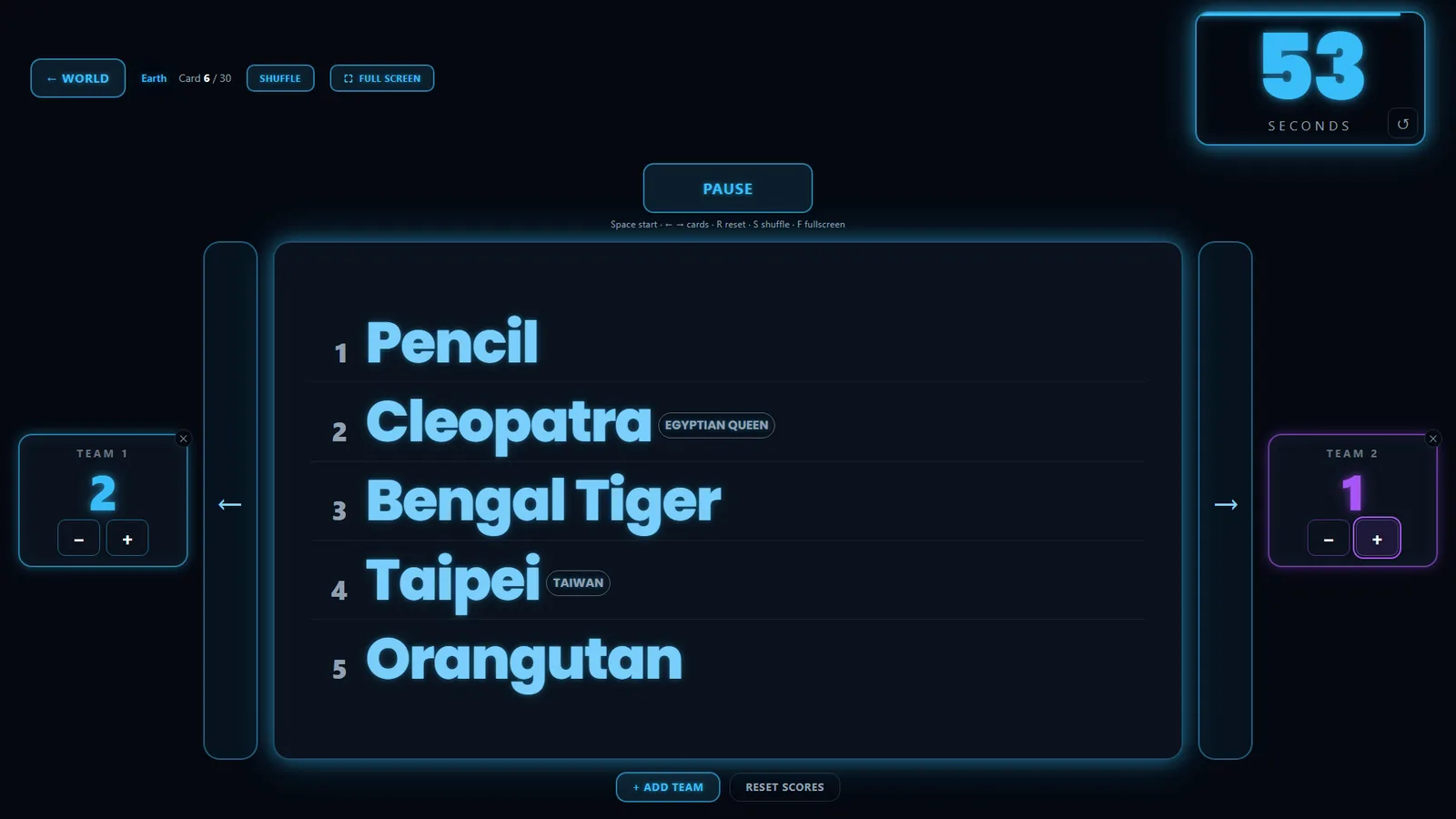
A speaking game for one projector. One card, five words, 59 seconds: one student describes, their team guesses, and nobody needs a device.

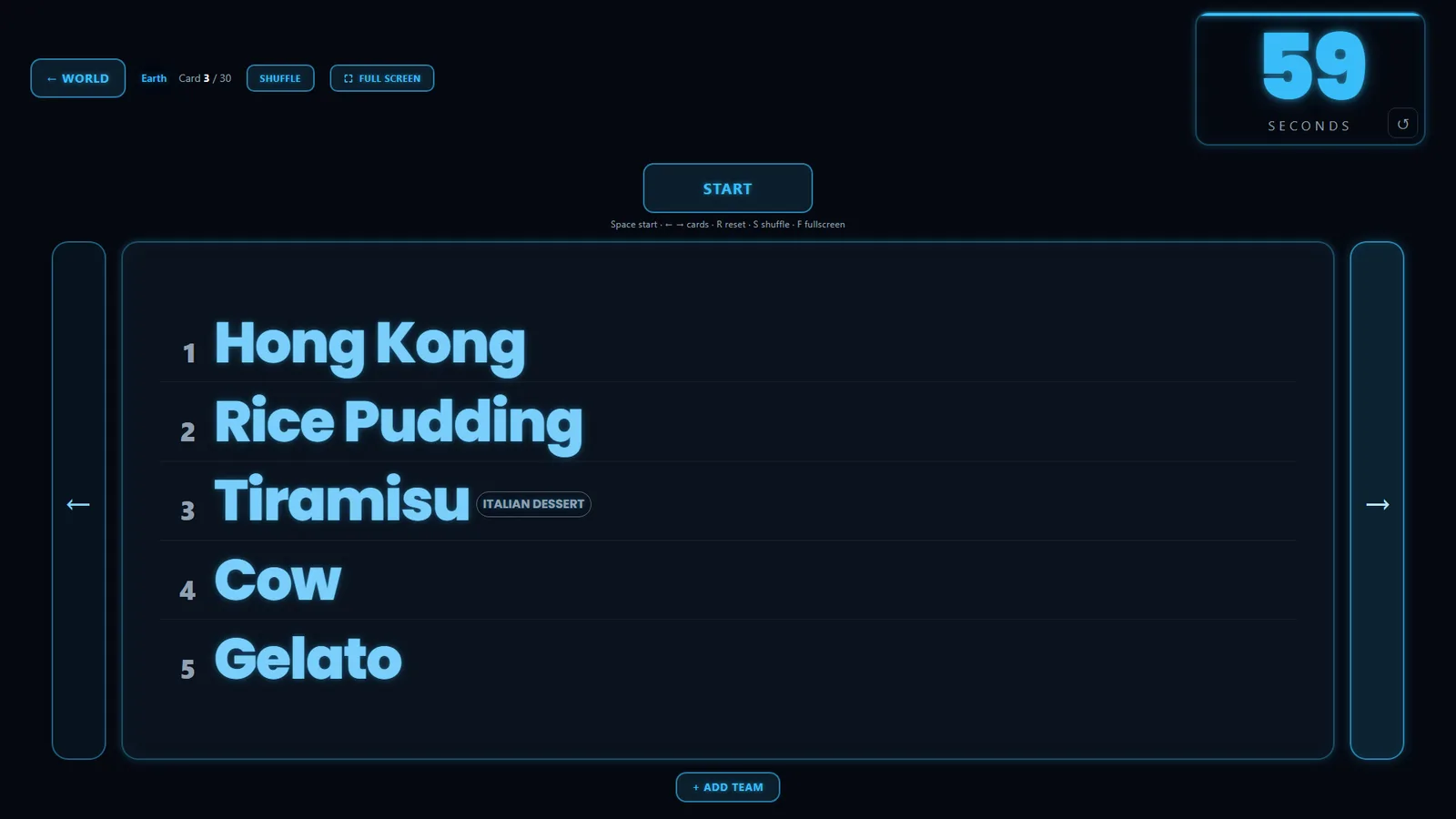
A 59 Seconds card: Hong Kong, Rice Pudding, Tiramisu, Cow, Gelato, with a 59-second timer.
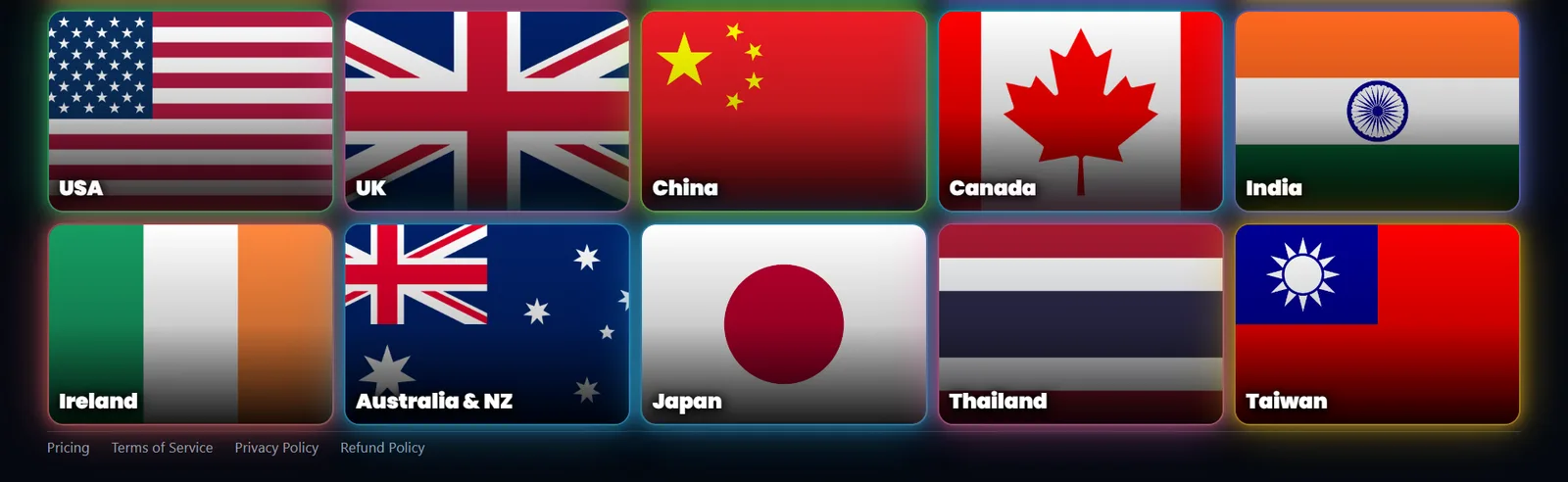
15packs, most of them local to one country or region
3,360cards in 112 decks
16,800words; one free deck per pack, no account
111automated tests passing

Counted on 7 October 2026 from the live site.

The problem

Students who can speak, but won't

The pattern I see most often in ESL classes is not students who cannot speak English, but students who will not, mostly from anxiety about speaking in front of others. Most classroom apps make it worse: they put each student behind a separate screen, with content written for somewhere else.

59 Seconds does the opposite. It is modelled on the party game 30 Seconds: one shared screen, students facing each other, and vocabulary from places they know, so a class in Seoul gets a Korea pack rather than references they have never heard of.

How it got here

  • June 2026: started as a Lovable scaffold, then built with Claude Code as my MSIT capstone at the University of the People.
  • July 2026: live at 59seconds.live, selling packs one at a time. No customer ever bought one; the only purchase was my own test.
  • August 2026: capstone report submitted.
  • September 2026: moved into Class Cookies. Pack sales ended on 23 September, the payment code was removed on 28 September, and 59seconds.live now redirects to the new address.
  • Today: locked decks are part of the Class Cookies subscription, open to subscribers since 16 October 2026, and a subscriber can mix their own word lists into a deck.
In the classroom

Built to be read from the back row

Huge type, a timer the teacher can change with one click, and nothing that moves on its own: the next card comes only when the teacher asks for it.

  • Keyboard shortcuts for the whole game: Space starts and pauses, the arrows change cards, R resets, S shuffles, F goes full screen.
  • A shuffled deck is used up before any card comes round again, so a class never sees a repeat mid-round.
  • Every card and pack is content in a database, added through an admin page, so a new pack is a content job rather than a code change.
Results

Measured, then and now

What testing found

In August, system tests run against the live site found that the end-of-round bell never rang, although every unit test passed. The timer logic was pulled into two small functions, and a regression test now plays whole rounds at six lengths and expects exactly one ring. The unit suite has grown from 24 tests then to 111 today, all passing.

Speed today

On 7 October 2026 the play screen, the page a class actually sees, scored 98 for Lighthouse Performance on desktop and 81 on mobile. That day the home page scored 81 on desktop, down from the 96 in the report, because it loaded about 2.4 MB of images, mostly two large tiles. Later on 7 October the tiles were replaced with resized copies; the project's own notes record the page weight falling from 2,653 KB to 361 KB and the score rising to 95 on desktop and 78 on mobile (Lighthouse 12.8.2, so not directly comparable). From Seoul the play page starts arriving in about 135 ms.

TanStack StartReact 19ViteTypeScriptTailwind CSS 4SupabaseVercel (Seoul)VitestWeb Audio API
The capstone

The full report

59 pages: literature review, design, implementation, evaluation and system testing, written for MSIT 5910 at the University of the People in August 2026. It describes the product as it was then.

Correction, 16 October 2026. The report says a refund removed access. The only live purchase was my own test, and its refund did not remove access at the time. 59 Seconds never had paying customers. It also says "One teacher who can code": I direct AI agents to write the code; I don't write it by hand.